Volos is a coastal port city near the Pagasitic Gulf in the region of Thessaly. The city has 86,046 inhabitants. To the east and south-east of Volos, the mountains of the Pelion peninsula extend into the Aegean Sea.
The synagogue of Volos is located in the city center close to the port and has been a part of the city for centuries.
During the second world war it was destroyed multiple times. But because of the Bishop Joakim, the German consul Helmuth Scheffel and kind villagers who tried to save the Jews of Volos, only 26 % of the Jewish Community of Volos were killed and deported by the Nazis.
Hence, the community still exists today. Even though it is small, the community has an active religious, cultural and social life.
Moreover, Volos is surrounded by mountain-villages, some of them fell victim to the Nazis’ retaliatory measures just like the small mountain-village Drakia. Today it is known as a martyred village, due to the bloody massacre in the night from the 17th – 18th December 1943 in which 126 men were killed by Germans.
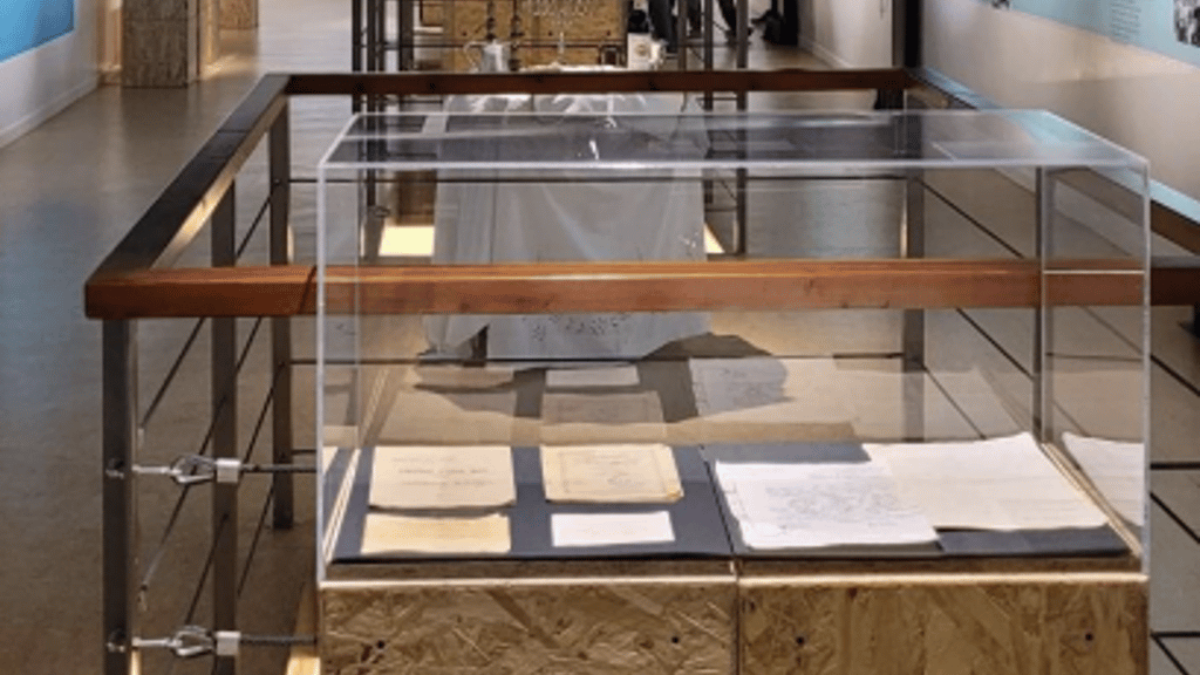
The history of these villages is reappraised in the City Museum of Volos. The exhibition is Greek, English and partially German.
Activities for Volunteers
As the volunteer position is relatively new, activities still need to be developed.
Possible activities are: helping the community’s office with administrative and organizational tasks at events, developing a visiting-service for elderly community members, translating the museum’s exhibition from English to German, doing research on the martyred villages
Requirements
Since the volunteer program in Volos is still new, the future volunteer needs to be very patient.
Trust and tasks are yet to be developed. Oftentimes new ideas are met with skepticism. For this reason, the volunteer has to bring not only motivation but also needs to show initiative.
Because very few members of the community speak English, the volunteer should speak/start to learn Greek in advance.
For the work in the museum good English skills are necessary.
Often, the volunteer takes part in Jewish holidays and events. That’s why the person should be respectful, friendly and curious about Jewish traditions.
Especially when working in Drakeia, the volunteer should show empathy and interest because very few Germans have visited the village before.
Building a social live can be very hard in Volos, because there are no other volunteers and the young person lives alone. Therefore, one should be open-minded, spontaneous, communicative and out-going in order to connect with students from the university or other young people.
Report about the first volunteer Lotta who is working in Volos (01.09.23-31.08.24)
Lotta in Volos – What is a girl from Neustrelitz (Germany) doing in Greece?
Lotta graduated from high school last year. Now she is in Volos (Greece) doing a year of peace work in the local Jewish community.
Because peace cannot be taken for granted. Since the end of last year, young graduate Lotta Bernendes-Pätz has been in Volos to do a year of voluntary work through the Action Reconciliation Service for Peace (ASF) association. The theme of her work is reconciliation. With German history, the Jewish communities and the people who were affected by Nazi crimes during the Holocaust. The association has set itself the task of countering current forms of anti-Semitism, racism, queer hostility and the exclusion of minorities through actively organised solidarity services.
Reconciliation service in Volos
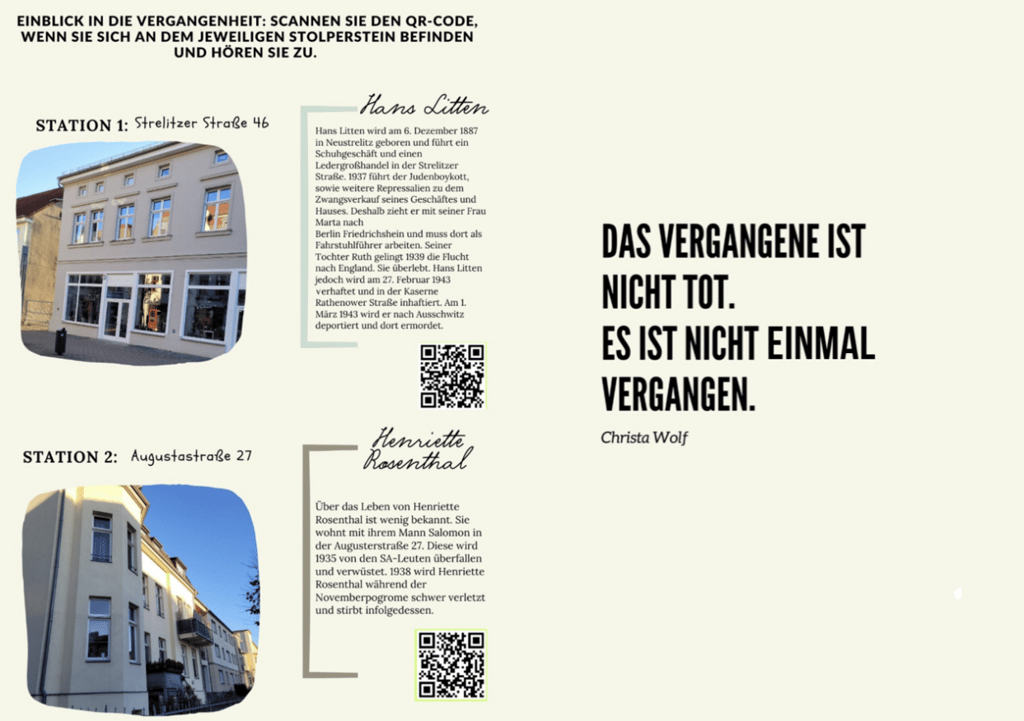
The Neustrelitz native knew early on that she wanted to spend a year abroad after graduating from high school. She also knew that she wanted to connect with the historically relevant topic of the Holocaust in some way. That’s how she came to ASF and Greece. Lotta currently works mainly in the office of the Jewish community in Volos. She does office work, prepares exhibitions and actively seeks dialogue with members of the community. She is also preparing a city tour. Incidentally, she has also created one for Neustrelitz. As part of a project for the summer school at the Carolinum in Neustrelitz, she designed an audio guide for the talking stumbling stones, 17 of which can be found in Neustrelitz.
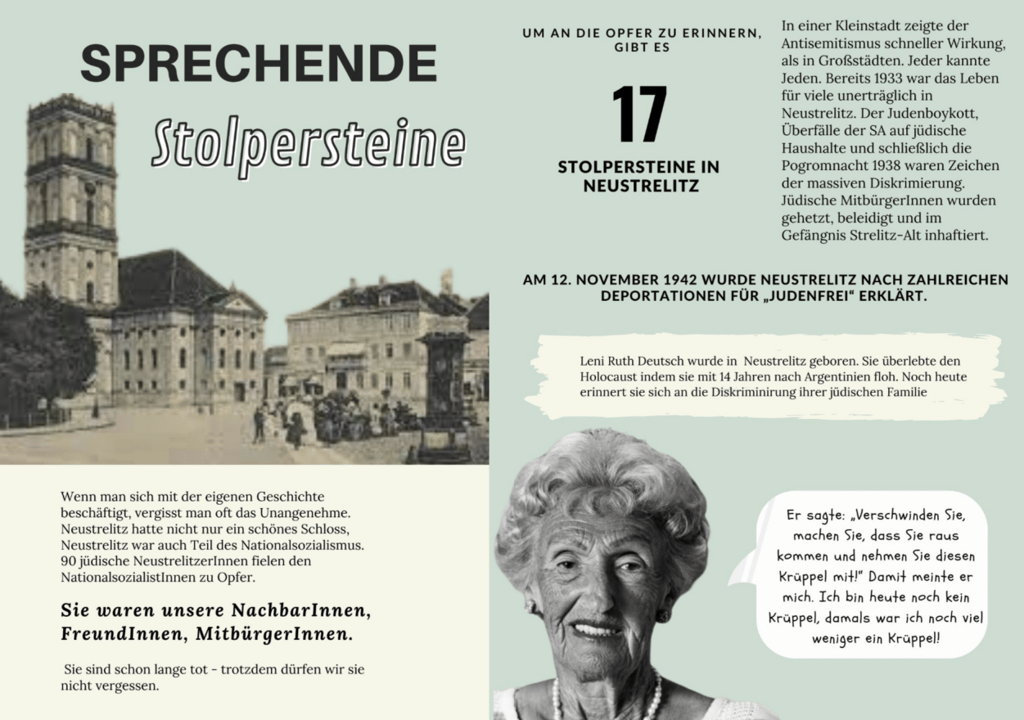
As part of a school project, Lotta Bernendes-Pätz created an audio guide to the 17 Stolpersteine in Neustrelitz. (Photo: ZVG / Lotta Bernendes-Pätz)
The accompanying flyer provides initial information about two victims of the Holocaust. Lotta Bernendes-Pätz compiled the relevant information herself from the Neustrelitz archives. (Photo: ZVG / Lotta Bernendes-Pätz)
“Never again” – that was yesterday!
She also spends a large part of her working time in the martyr village of Volos. Martyr villages and towns are places in Greece where war crimes were committed on a large scale during the Nazi era. “On Holocaust Remembrance Day, I was taken by the hand and shown around by an old man who said I was the first German he had ever seen in the village,” Lotta recounts. Nearly all the men in the village were executed during the Second World War. The old man treated her with great respect. “Actually, I expected that because of my background, I would be threatened with a comment or two,” she admits. So far, however, she has only been met with kindness. “It’s crazy when you consider what’s going on in Germany right now.”
In Volos, she experiences every day how far the Nazi crimes reached and how they continue to shape people today. The Jewish community in Volos, for example, once consisted of several hundred members. Now there are barely a hundred left. “We repeat it over and over again, even at school, as a cliché: this must never happen again,” says the barely 19-year-old abruptly. “But to achieve that, we all have to take active steps.”
Security measures have been stepped up
She has seen in many situations how topical the issues of anti-Semitism, racism and hatred of minorities in general are. With the outbreak of the Gaza-Israel conflict, for example, a member of the community lost his niece. The Middle East conflict is an incredibly complex issue, says the young volunteer. She said she could not pass judgement on it. But what she wanted to talk about was how shocked she was at how anti-Semitism and racial hatred were re-emerging as a matter of course in the context of such events, even in Germany and Greece. On 6 January, for example, the Holocaust memorial in the city of Volos was daubed with Nazi symbols and racist slogans. Security measures have now been tightened once again. There are police officers, cameras in offices and checks everywhere. For her, this is a strange feeling, because: “I don’t belong to a minority.” She is white, privileged and Christian. It is disturbing to see how difficult it is for some people.
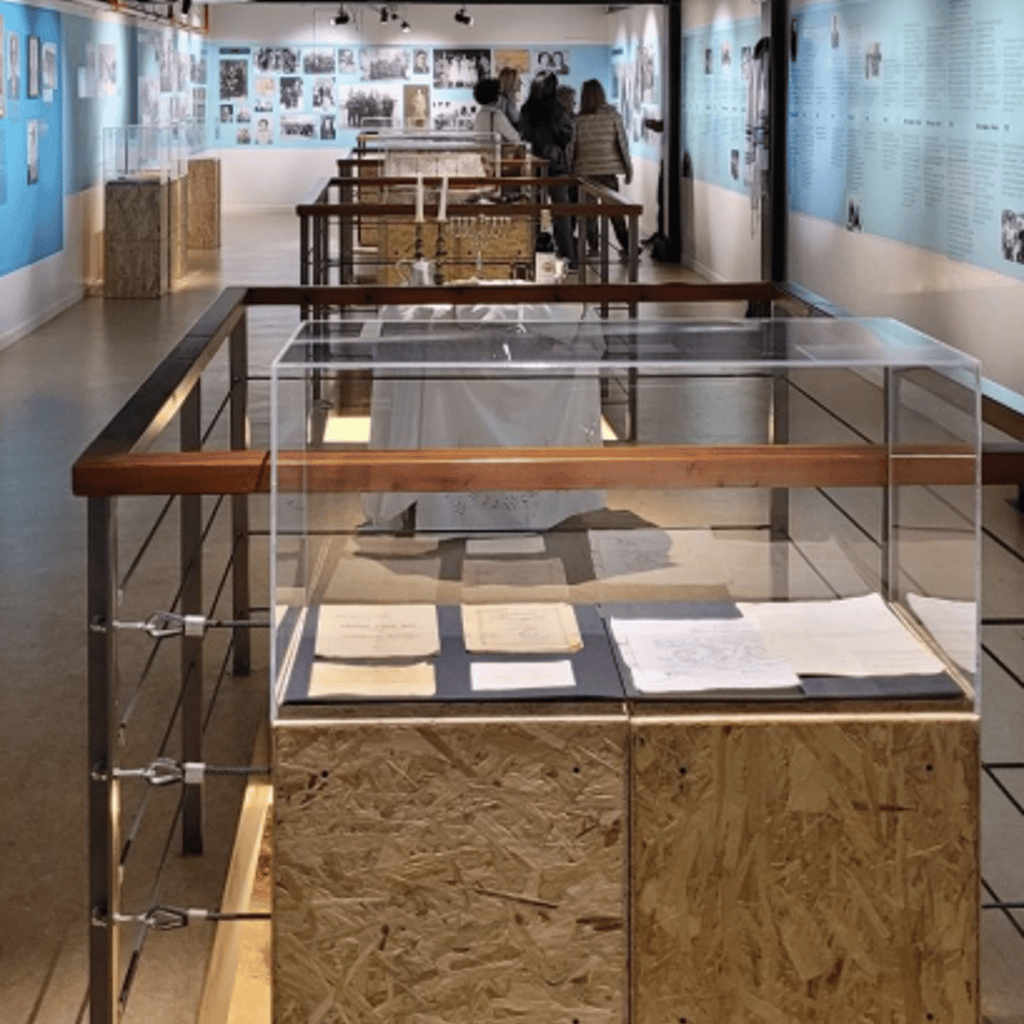
Lotta helped organise an exhibition on the Nazi past in Volos. ‘Current developments in Germany prove it,’ says the 19-year-old. ‘Not enough has been said about this topic yet.’ (Photo: ZVG / Lotta Bernendes-Pätz)
‘Even though it sounds strange, because those affected don’t have this option at all,” says Lotta, “sometimes I have to turn away from these issues and just spend time with friends in the city.” Getting to know the beautiful sides of Greek life is an important and happy balance.
They moved into the multi-generational house together.
In order to qualify for the voluntary year, applicants must complete an internship. Lotta decided to do an internship at the multi-generational house in Neustrelitz. Because her grandmother loves spending time there.
“Many of the people there have family histories that connect them to the subject,” she says. “Then there was also the fact that her own father was not against the Nazis, at least.” Some did not want to face the subject, while others were of the opinion that in the end it had not been so bad, especially in Greece. She has great understanding for this, says the high school graduate. “It was nice that in the end everyone was open to discussion.” What’s more, the visitors to the multi-generational house surprisingly and spontaneously put together donations, sometimes just one or two euros, sometimes ten. Now they are officially sponsoring the high school graduate for this year of peace work. In return, they receive regular reports from Volos. “We always show them on a screen in our rooms and then talk about them afterwards,” says Astrid Matz, coordinator of the multi-generational house project in Neustrelitz. The next date is already set: the latest report will be presented on 23 February at 10 a.m.
At the end of August, Lotta Bernendes-Pätz will finish her year of voluntary service and return to Germany. She wants to study in order to pursue a career as a journalist.
This report comes from the Nordkurier newspaper and was written by Maria Häfer and published on 22 February 2024.
Here you can find the original article: https://www.nordkurier.de/regional/neustrelitz/lotta-in-volos-was-macht-eine-neustrelitzerin-in-griechenland-2280974
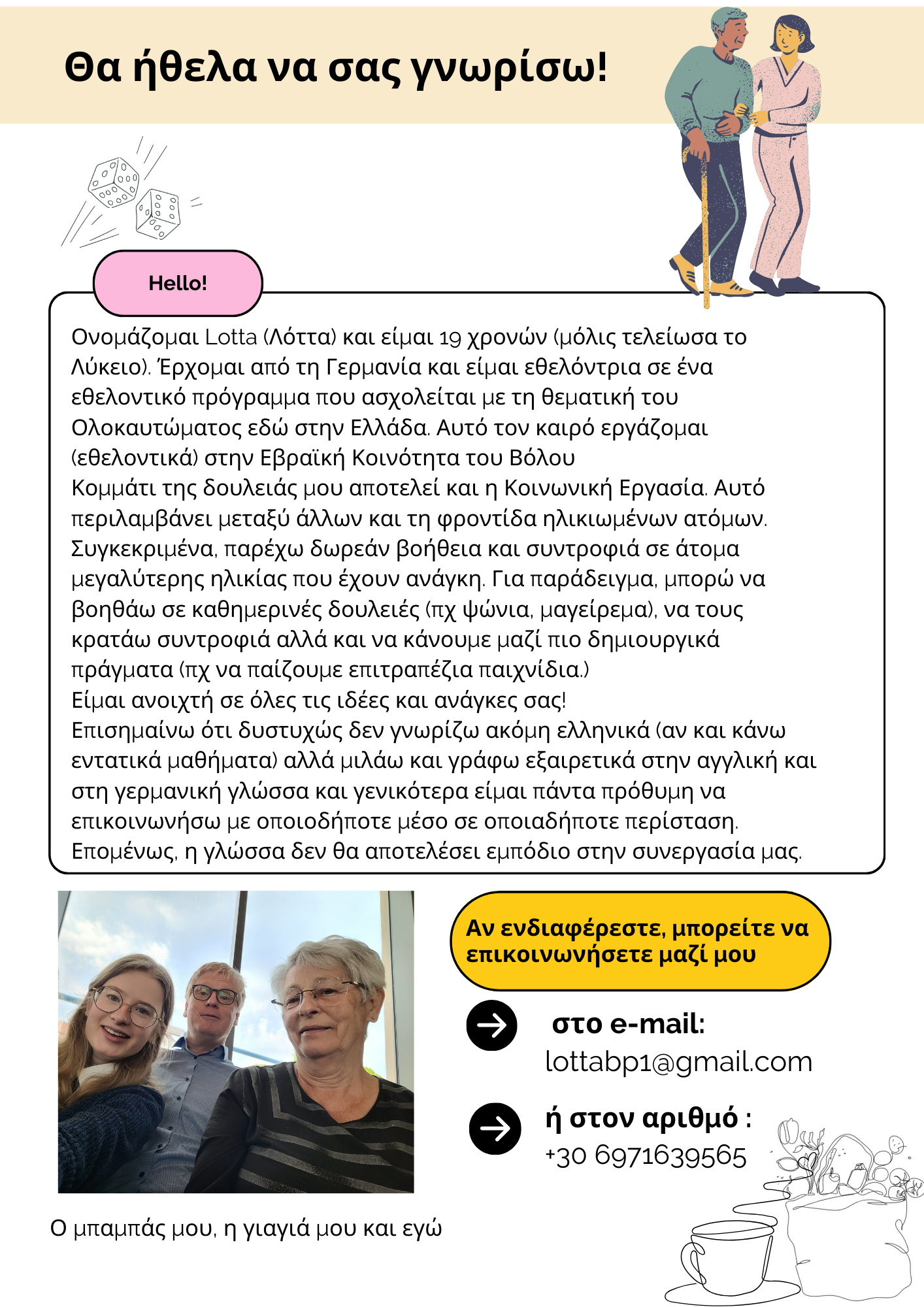
Lotta has recently started offering a visiting service for elderly people. She has designed a flyer for this service, which you can download and view here. Flyer-Besuchsdienst-4Download