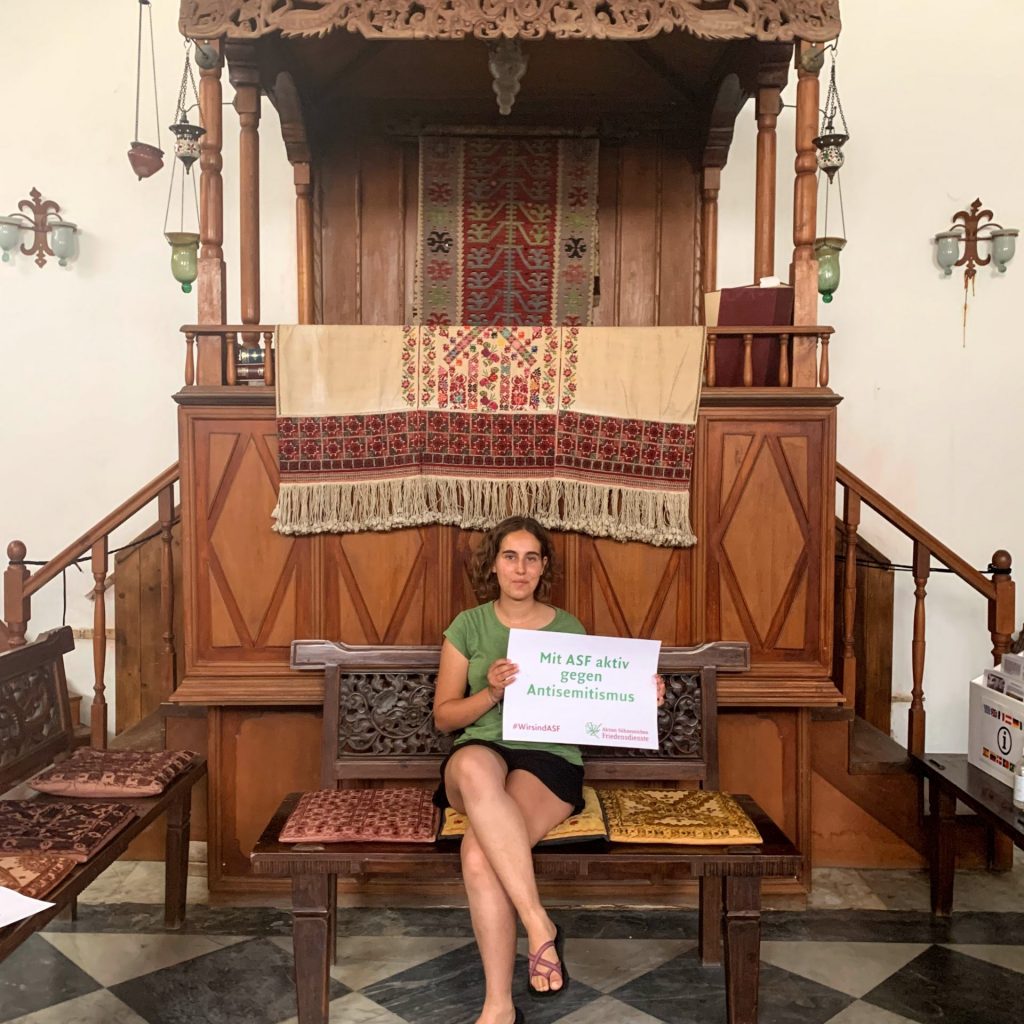
Until 1999, Etz Hayyim was a desecrated house of prayer, which remained the only Jewish monument in Crete after the destruction of the Jewish community in 1944. It stood as a monument to the National Socialist extermination of 2,300 years of Jewish life in Crete.
From 1996 to the year of its re-inauguration in 1999, the building has been carefully restored. The philosophy behind this work is summed up in the Hebrew ’Am Israel Hayy’ – ’The people of Israel live’.
The synagogue is run by an association that focuses on the cultural heritage of the destroyed Jewish communities of Crete. The association also organises a variety of cultural events and educational programmes. Here, for example, lectures, readings and musical events take place.
The Synagogue Association is networked with other denominational, political and historical working groups and is committed to fighting against anti-Semitism, racism and other forms of group-based hostility to humanity.
Activities for volunteers:
Visitor support, assistance at events, attendance service
Cooperation with a volunteer of the Austrian Memorial Service
In combination with Etz Hayyim: Support for the initiative “Young Citizens of the World Chania”, which builds a small documentation centre based on the consequences of the German occupation on Crete and an open library (http://www.creative-intercultural-dialogue.org/neoi-polites.html)
Requirements:
Etz Hayyim is a small institution of international renown. “Young Citizens of the world” is a small political-artistic initiative with a very familiar working environment. The volunteer needs a reliable, independent personality and should be able to cope with chaotic situations. Respect for the confessional partner is also a basic requirement. This project is appealing for someone with an interest in Jewish history, culture and religion.
Report by the ASF volunteer Liana Danisch working in Chania (01.09.25 – 31.08.26)
My work at the synagogue was varied and depended heavily on the seasons and the number of visitors. My day usually began with preparing the synagogue for visitors. After that, I gave tours in German of English, answered questions and provided information abouut Jewish history in Crete and Etz Hayyim’s current approach. On fridays I started the preparations for the Sabbat-service and participated in it.
I also got to know the Jewish holidays RoshHa-Shana, Yom Kippur, Sukkot, SImhat Tora and Pessach and participate in many different traditions. One of my most beautiful experiences were the festivities of Pessach/Passover. After the preparation, consisting of cleaning the Synagogue and preparing the meals for the evening, the Passover holiday was kicked off with a service and a big seder dinner. I especially liked the rituals and the interpretation of Haggadah (religious text to set forth the Passover) of the Etz Hayyim Synagogue, which offered a lot of food for thought amd critically examines itself and its environment. Through that I realized hoe much I had learned in the past months and how comfortable I felt at this place.
Aditionally, through various projects I got to know about many different areas. I aided with events, created a monthly newsletter, released my personal project of the year and helped with the social media channels.
Especially getting to know so many different people and the many conversations meant a great lot to me, through which my year was incredibly enriched.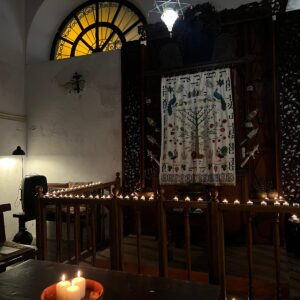
Since the Etz Hayyim Synagogue is also a memorial, I was able to be part of commemorations events. I was particularly touched by the Tanaïs Memorial on June 14. 82 years after the sinking of the ship, for everyone of the 260 people, a candle was lit and every name of the deceased was read out loud. the Tanaïs conference as well, gave me the opportunity to engange a lot more intensly with remembrance culture and culture and learn something new about the holocaust, ship disasters and refugee routes of the 20th century.
The voluntary service offered the opportunity to further develop my personal skills and learn about new and valuable perspectives. I am very glad I had the opportunity to get to know the Jewish community so closely and to have been in such an intense engagement with this religion. To also see that open-minded institutions such as Etz Hayyim exist and offer a new perspective on tolerance and remembrance culture and learn something new about the holocaust, ship disasters and refugee routes of the 20th century.
The voluntary service offered the opportunity to further develop my personal skills and learn about new and valuable perspectives was one of the most important parts of my experiences. I was able to learn many new things, have had so many special experiences, that I could take home with me.
Report by the ASF volunteer Thora Bilz who is working in Chania ( 01.09.22 – 31.08.23)

When I first walked through the wooden door of Etz Hayyim synagogue, I thought “What a beautiful and comforting place”. The nearly two months I have spent in Chania since were an adventurous, interesting and eventful time. In my first week I watched my colleagues give tours, talked to visitors and begun to read into Jewish life and history on Crete. It was a perfect quiet start before the exciting time of Jewish holidays followed.
The first holiday we celebrated was the Jewish New Year: Rosh Hashanah. We welcomed the year 5783 by hosting a big dinner attended by 100 people. While the guests took part in the service, we prepared tables and got the food from a nearby restaurant. There are certain symbolic foods served at a Rosh Hashanah dinner. For example: Eating a fish head on Rosh Hashanah symbolizes the desire to be “heads, not tails” in the new year. It was so interesting to listen to the rabbi explaining these costumes and trying these traditional foods. On the following day I heard the powerful and loud sound of the Shofar for the first time. A shofar is a ram’s horn that is blown on Rosh Hashanah (the day of the (shofar) blast).
In the next week we celebrated Yom Kippur, the day of Atonement and holiest day of the Jewish calendar. There were various services I listened to, I got to witness the fasting and its breaking and, in the end, got to hear the shofar again that symbolizes the end of the holiday. The next two weeks Sukkot and finally Simchat Torah followed. Sukkot is the harvest festival. We built up the Sukkah hut and I decorated it with fruits. In the next few days prayers that were marked by processions with the lulav (palm branch with myrtle and willow) and etrog (citron) were held in this hut. Simchat Torah was the end of our holiday marathon. It is celebrated with singing, dancing, and merry processions of people carrying Torahs.
While I really liked the services and Torah readings and am so glad that I got to know all these Jewish traditions, the thing I enjoyed most about the holidays was talking to Jewish people from all around the world. We had so many different people joining us for the holidays that were open to share about their lives and the history of their families. It was so interesting, and, I think, very special.
The last two weeks I became a member of the tour-giving team of the synagogue. I gave tours in English and German, talked to visitors and took care of the Etz-Hayyim book shop. I look forward to all the interesting projects coming this winter and am grateful that I get to spend one whole year at this beautiful place!
Report by the first ASF volunteer Carleen working in Chania (01.09.21 – 31.08.22)
“My working day begins at ten o’clock with the preparation of the synagogue for visitors, e.g. preparation of items for sale. Afterwards, the team discusses the tasks for the day at breakfast together.
I am currently working with Theo, my Austrian co-volunteer from GEDENKDIENST, on a historic city rally for a youth exchange with students of the FU from Berlin, where young people from Chania and the students get to know each other.
During our working hours the synagogue is regularly visited by people of different nations, to whom we show the premises and also give short guided tours according to their interest. That is why I invested time in the first few days to study the history of the place and the Jewish community of Crete.
Every Friday evening the Sabbath is celebrated in the synagogue, where I help with the preparation and follow-up, as well as participating in prayer. Even if this is not part of my working hours, it has always been exciting and beautiful experiences for me so far, because one is received in a friendly way by the community and thus gets first impressions of Jewish culture. During the first weeks, I also had the opportunity to get an insight into the Jewish holidays of Yom Kippur and Sukkot. To better follow the prayers Theo and I participate in Hebrew Reading lessons.
I also renew our website, write articles for our newsletter or help with all kinds of current projects. Apart from all that I also take part in community events like Passover. Due to that, I have learnt a lot about Jewish culture and I hope to further enrich this knowledge in the next months!”
In cooperation with:

